MOUNTAIN VIEW / YOUR LIVING ROOM—YouTube announced Tuesday that it will begin placing advertisements inside other advertisements, completing the company’s gradual transition from a video-sharing website into a commercial break that occasionally contains footage of someone repairing a lawn mower.
The new format, called the Nested Advertising Experience, will begin with a short advertisement informing viewers which advertisements they can expect during the longer advertisement immediately ahead.
“We heard that viewers wanted fewer interruptions,” said YouTube Vice President of Monetization Experience Trent Buffering. “By combining six separate annoyances into one uninterrupted sequence of annoyance, we have technically delivered exactly that.”
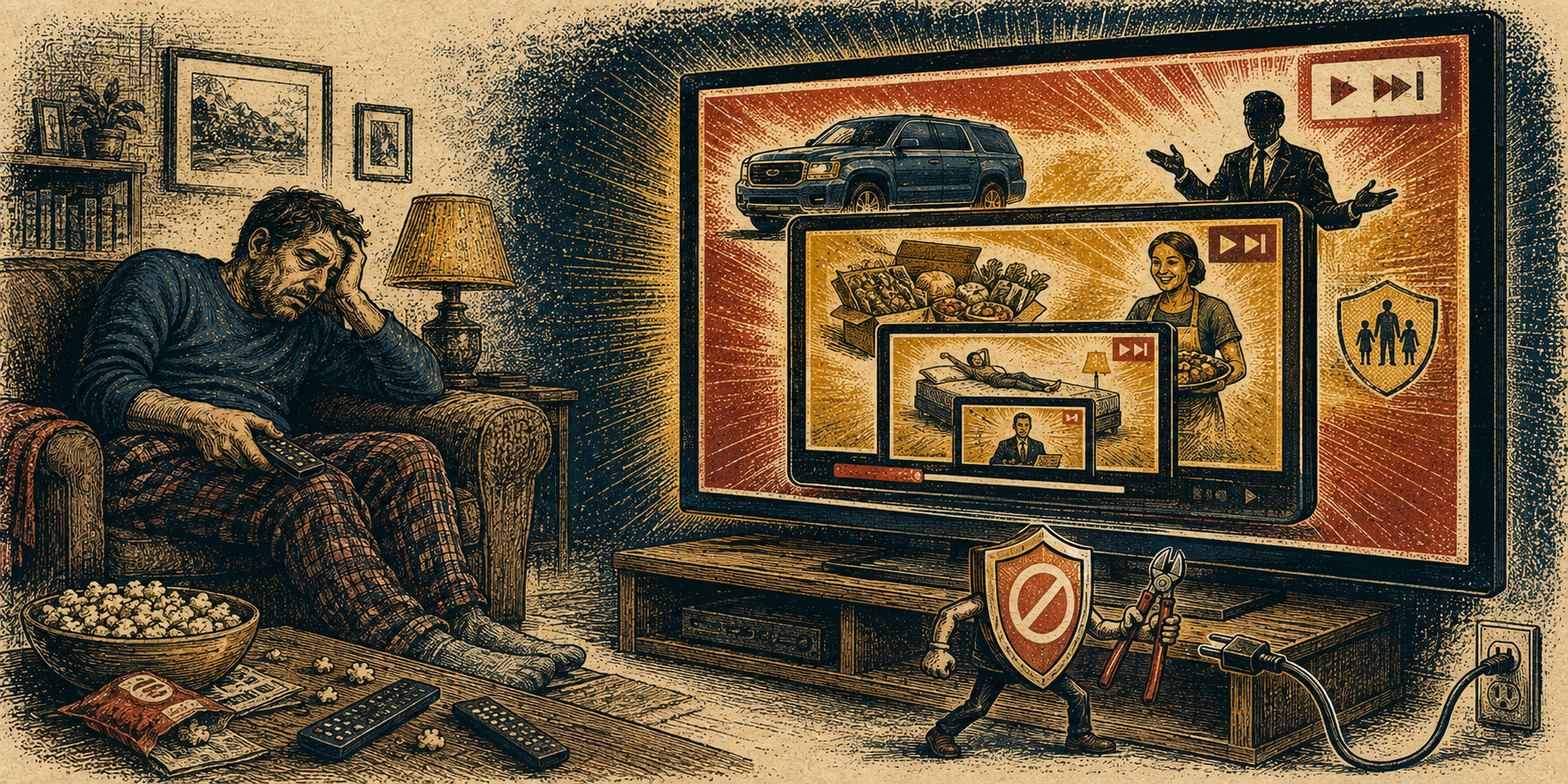
Under the new system, a viewer selecting a twelve-minute cooking video may first encounter a thirty-second insurance commercial, followed by a five-second advertisement for the insurance commercial, followed by a brief message thanking the viewer for continuing to watch advertisements on YouTube.
The cooking video will then begin with the creator saying, “Before we get started, I want to thank today’s sponsor.”
“Viewers should no longer have to wonder whether they are watching the video or an ad. The answer will always be yes.”— Trent Buffering, Vice President of Monetization Experience
Fewer interruptions, considerably more interrupting
YouTube has already grouped advertisements into longer breaks on connected televisions, saying research found many viewers preferred several ads together instead of frequent interruptions throughout a long video.
The platform has interpreted this preference as broad public support for transforming every television into the small screen at a gas pump.
Users have recently complained of repeated commercials, multiple unskippable ads, and ad breaks long enough to forget which video they originally selected. Several reported that their most reliable Skip button is now the Home button on the remote.
YouTube analytics reportedly categorizes this behavior as “successful off-platform engagement.”
The Improved Viewer Journey
One click. Fewer interruptions.*
The company also confirmed that artificial intelligence will continue selecting natural places for mid-roll ads, including immediately before the answer to a question, halfway through the sentence containing the answer, and three seconds after the viewer has shouted, “Oh, come on.”
For added transparency, television viewers will receive a countdown showing exactly how much time remains before YouTube replaces it with a different countdown.
Premium subscribers eligible for premium advertisements
YouTube assured paying customers that the new advertisements would respect the benefits of their subscriptions.
Full Premium members will continue seeing creator sponsorships embedded directly in videos, while Premium Lite subscribers may still encounter ads on music, Shorts, search pages, and other areas classified under the increasingly flexible category of “YouTube.”
“This is not an advertisement,” a company representative clarified. “It is a premium reminder that an additional premium exists.”
Executives are reportedly considering a third subscription called YouTube Premium Actual, which would remove every advertisement except the monthly video explaining why the price has increased.
A proposed fourth tier, YouTube Premium Leave Me Alone, would cost $38.99 per month and allow subscribers to watch one man replace a garbage disposal without being informed about meal kits, mattresses, mobile games, website builders, identity protection, or the revolutionary wallet currently disrupting the ancient pocket industry.
Ad blocker blocks regional power grid
Representatives of the advertising-blocking industry responded to the Nested Advertising Experience by announcing that their software would simply block electricity from reaching the user’s home.
“We began by hiding banners,” said uBlock engineer Hal Filterlist, speaking from a bunker containing sixteen monitors and no functioning version of Chrome. “Then we blocked pre-rolls, pop-ups, overlays, trackers, anti-blocker warnings, and the warning informing us that we had blocked the anti-blocker warning.”
“At this point, the most reliable technical solution is to shut down the computer, remove the utility pole, and make Google advertise against the night sky.”
The blocker will reportedly detect when a user attempts to open YouTube and immediately trip the circuit breaker, producing what developers describe as “the cleanest viewing experience currently available.”
YouTube responded within hours by testing advertisements on candles.
The escalation is the latest stage in a prolonged struggle between YouTube and ad-blocking tools. Each new detection method produces a workaround, which produces another detection method, which produces a seventeen-step Reddit post advising users to install Firefox, clear four caches, update eleven filter lists, and sacrifice one Chromecast beneath a full moon.
YouTube maintains that advertising supports creators. Ad-blocker users maintain that they would be more receptive to this argument if the same advertisement did not support the creator eight times during a ten-minute video.
Creators, meanwhile, confirmed that they would prefer viewers not block the ads, skip the sponsor, mute the affiliate pitch, close the merchandise window, or remember that the actual subject of the video could have been explained in two paragraphs.
Remaining video declared ad inventory
Industry analysts expect the nested format to generate significant revenue until viewers develop the ability to recognize that they did not actually need to watch anything.
The company’s long-term roadmap reportedly calls for ads before pausing, ads after pausing, ads displayed while deciding what to watch, and a short unskippable commercial that appears whenever the television detects someone saying, “At least it’s free.”
YouTube denied that it plans to eliminate videos entirely.
“Creator content remains central to the YouTube experience,” Buffering said. “Without it, there would be nothing to interrupt.”
At press time, an ad blocker had successfully removed every commercial from a YouTube video but had also removed the video, the browser, Windows, and a nearby smart refrigerator that was beginning to ask too many questions.
YouTube says it groups ads on long TV videos to create fewer breaks and offers automatic mid-roll placement on videos eight minutes or longer. Its documentation also notes that Premium viewers may still see creator-embedded promotions, while Premium Lite retains ads in several parts of the service. Recent user discussions describe repeated ads, consecutive unskippable spots, and abandoning videos rather than waiting.